People have been saying the deck is dead for ten years. Every year, someone publishes a think piece about how presentations are relics, how nobody reads slides, how the future is all async video and Notion docs and Loom walkthroughs.
And every year, someone opens PowerPoint and builds the thing that changes a company's direction.
I've been on both sides. As a Strategy Leader at agencies, I spent years crafting pitches with my team. Some of them were forgettable. Some of them were transcendent. And the difference between those two outcomes taught me everything I know about what a deck actually is - and isn't.
The Rise of the Almighty Pitch
There's a reason the pitch deck became the lingua franca of modern business. It's not because people love staring at bullet points in a conference room. It's because a great deck does something almost nothing else can: it takes an abstract idea and makes it feel inevitable.
Think about the best presentation you've ever seen. Not the longest one. Not the one with the most data. The one where, 10 minutes in, the entire room was leaning forward. Where someone said "yes" before you even got to the ask.
That's not slides. That's ideas, visualized. Documentation, storytelling - these are powerful things. They inspire big ships to get moving. When done right, a deck can rally an entire organization to do something truly special.
I loved working with my team on crafting the perfect pitch, especially when we knew we'd experienced a true "aha moment" that was going to blow the client away. There's an electricity in the room when you land one of those. The strategic insight clicks. The creative execution makes people feel something. The roadmap feels not just achievable but exciting.
Those moments are rare. But they're the reason decks exist.
The $12,000 Deck
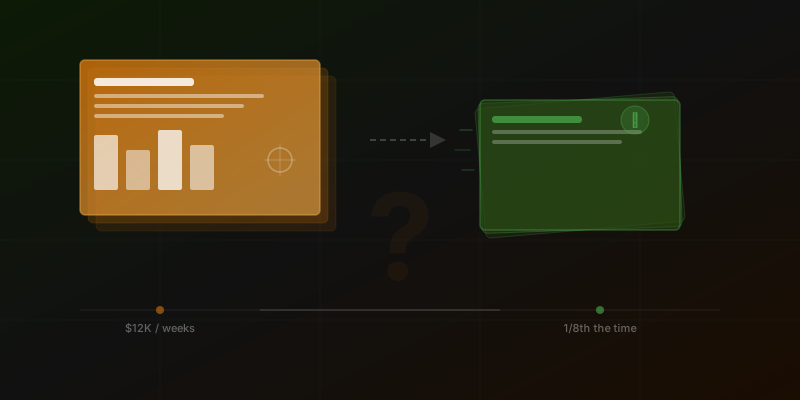
Having some visibility into retainers and SOWs, I could see what clients were actually paying for the very best decks. Sometimes it was $12,000. For slides.
That number sounds absurd until you understand what goes into it.

A great agency deck isn't a designer opening a template. It's a strategist spending 15 hours in data, competitive research, and customer interviews. It's a creative director shaping a narrative arc. It's a designer building custom visuals that make complex ideas feel simple. It's three rounds of internal review before the client ever sees it. It's a project manager coordinating all of those people across timelines and feedback loops.
When it works - when the strategy is sharp, the story is tight, and the design elevates both - $12,000 is a bargain. I've seen a single deck secure a $2M budget. I've seen a 30-slide presentation realign an entire company's go-to-market. The ROI on those decks was 100x or more.
The problem is that it doesn't always work.
When the Deck Collects Dust
For every deck that changed a company's trajectory, there are a hundred that went nowhere. Decks built to justify someone's job. Decks built because "the CMO likes decks." Decks built because the agency needed to show deliverables to justify the retainer.
When a deck sucks - and far too many frankly do - the deck collects dust, the ideas are dead, and the money is lost. The PDF sits in a shared drive somewhere, never opened again after the initial meeting. The "strategic roadmap" becomes a historical artifact within weeks.
The failure mode isn't the format. It's the thinking. Bad strategy doesn't become good strategy because you put it in Keynote with a nice gradient. A weak insight doesn't sharpen because a designer made it look clean.
No deck ever drove a single dollar of revenue on its own. A deck is a vehicle. The value is always in the idea, the conviction it creates, and the action it inspires.
Enter AI: One-Eighth the Time
Here's where it gets interesting. With the rise of AI tools, I can now produce beautiful, thoughtful, impactful slides in about one-eighth of the time it used to take.

What used to require a strategist, designer, and PM across 40-80 hours can now happen in a focused afternoon. AI handles the structure. AI generates the first-draft visuals. AI helps pressure-test the narrative flow. The human work - the strategic insight, the storytelling instinct, the judgment about what matters - stays human. But everything around it accelerates.
I only expect that to compound. The tools get better every quarter. The templates get smarter. The ability to go from insight to polished output shrinks from hours to minutes.
Now I spend about 5% of my time creating slide content. It's still important - decks still open doors, align teams, and communicate strategy. But the economics have fundamentally shifted. What used to be a $12,000 agency deliverable can now be produced by one operator with the right tools and the right strategic foundation.
What This Means for How We Work
The shift isn't that decks don't matter. It's that the cost of making one just collapsed. And when the cost of production collapses, the value migrates upstream - to the thinking, the strategy, the insight that makes a deck worth building in the first place.
This is the pattern across every creative discipline AI touches. Design, content, analysis, reporting - the production layer gets cheaper and faster. The strategic layer gets more valuable. The people who thrive are the ones who were always focused on the thinking, not the formatting.
For agencies, this is uncomfortable. A significant portion of their revenue has historically come from production work - including deck creation. When a solo operator can produce the same quality output in a fraction of the time, the agency markup on production becomes harder to justify.
For operators and strategists, it's liberating. You can spend your time on the part that actually matters - the insight, the narrative, the recommendation - and let AI handle the part that used to eat 80% of the timeline.
Is the Deck Finally Dead?
No. And I don't think it ever will be.
People have been declaring the death of the deck for a decade. They said email would kill it. Then Slack. Then async video. Then collaborative docs. And yet, when the stakes are high - when someone needs to secure budget, pitch an investor, align a leadership team, or launch a new initiative - they build a deck.
Because it was never about the deck. It was about what a great deck does: take a complex idea, shape it into a story, and make a room full of people believe it's possible.
The format survives because the need survives. People need to see ideas before they can believe in them. They need narrative structure. They need something to react to, to debate, to rally around.
What's dying isn't the deck. It's the era when building one required a team, a timeline, and a five-figure budget. AI compressed the production side. The strategic side - the aha moment, the narrative arc, the conviction - that's still entirely human.
If I'm being honest, part of me will always miss the heyday of the deck. The late nights with a team, refining every transition. The energy of walking into a pitch knowing you had something special. The craft of it.
But the craft was never really in the slides. It was in the thinking. And that part isn't going anywhere.
The Bottom Line
The deck isn't dead. The premium on deck production is. AI didn't kill the pitch - it democratized it. The barrier to a beautiful, well-structured presentation used to be budget and headcount. Now it's just strategic clarity.
If you have something worth saying, you can say it in slides faster and cheaper than ever before. If you don't have something worth saying, no amount of production polish will save you.
That's always been true. AI just made it impossible to ignore.