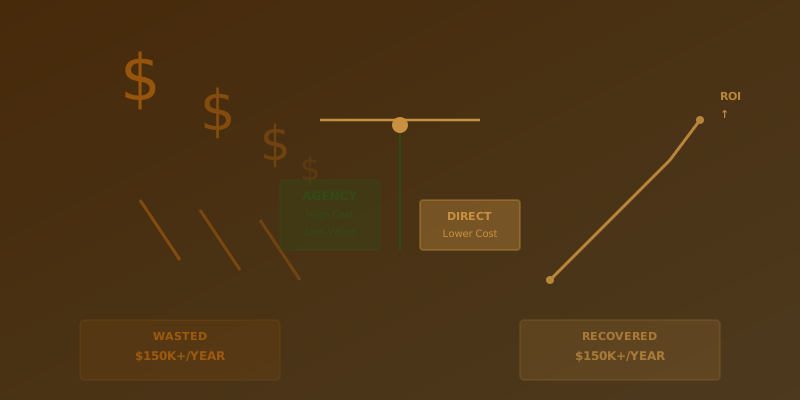
You're paying a digital agency $15K to $30K per month. You've got a dedicated account manager checking in monthly. A project manager keeping things on schedule. A junior strategist writing content. A designer refreshing assets. When something breaks, there's a queue.
You're wondering if you're getting your money's worth. You probably aren't.
I'm not here to bash agencies. They do important work, especially at scale. But there's a specific tier - growth-stage businesses with $2M-$20M revenue doing $5K-$15K/month on digital strategy - where agencies are the wrong tool. You're paying for their overhead when what you need is senior thinking.
Let me walk you through the math.
The Agency Markup Machine
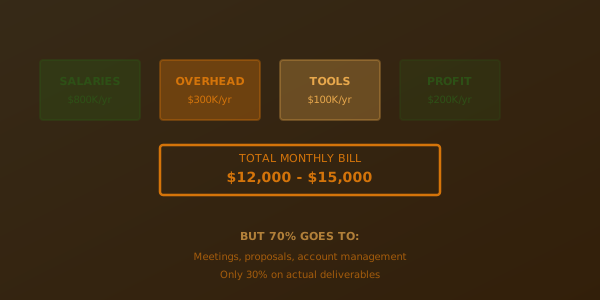
Here's what a typical $20K/month retainer looks like at a mid-size agency:
Revenue: $20,000
Costs:
- Senior strategist (the person in your pitch): $150K/year salary = $12,500/month
- Account manager (checking in monthly): $80K/year = $6,667/month
- Project manager (managing timelines): $70K/year = $5,833/month
- Junior strategist (doing the actual work): $60K/year = $5,000/month
- Designer (refreshing things): $70K/year = $5,833/month
- Overhead (office, software, benefits, recruiting, sales): ~$8,000/month
Total: ~$43,333/month in costs
Wait, that doesn't add up. How does a $20K client pay for $43K in costs?
Simple: they don't. That's why agencies have 3-5 clients per person. The senior strategist is split across five clients ($62,500 revenue). The account manager handles eight clients ($53,333 revenue). The junior strategist handles four clients ($20,000 revenue). Overhead is spread.
On paper, it pencils. In practice, here's what happens:
What You're Actually Paying For
Your strategic thinking (5-10% of billing): The senior strategist is in your pitch and your quarterly reviews. That's maybe 2-3 hours per month. The rest of the time? Managing other clients or running the business. You're paying for access to a senior person, not their dedicated time.
Account management (20-25% of billing): Your account manager is checking in, writing status updates, scheduling calls. They're not thinking about your business. They're administering your relationship. If something goes wrong, they're the messenger, not the problem-solver.
Project management (15-20% of billing): Timelines, deliverables, Gantt charts. Important for large-scale production work. Less relevant for strategy.
Junior execution (30-40% of billing): This is where the work gets done. Content, analysis, reports. But it's not senior thinking. It's implementation of strategy that was already decided.
Overhead (15-20% of billing): Office, software, recruitment, sales, administrative costs. You're funding their operation.
The Core Problem: You're Paying for Layers
Here's what the chain looks like:
Client → Account Manager → Project Manager → Junior Strategist → Execution
Each layer adds time, introduces potential miscommunication, and adds cost. The senior strategist who has the insight is three or four people away from the execution.
At a $20K/month retainer, the math requires multiple people to justify the cost. If an agency only charged you for one strategist at senior rates, the fee would be $6K-$8K/month. But then they couldn't cover overhead for a full team and a building.
So they add layers. Account managers. Project managers. Approval processes. Meeting cadences. The structure bloats the cost.
Where Agencies Waste Your Money
1. People You Don't Need
Do you need an account manager? Maybe. Probably not. An account manager's job is status updates and relationship management. A skilled strategist communicates directly. An account manager costs $6,600/month. That's someone doing a job you don't need done.
2. Meetings You Don't Need
Monthly check-ins. Quarterly business reviews. Steering committee meetings. Weekly status calls. Each adds coordination overhead and slows decision-making. It feels like service. It's actually inefficiency dressed up as service.
3. Process Over Results
Agencies need process because they manage multiple clients and multiple people. They need approval chains to prevent juniors from making bad calls. They need documentation because employees turn over. The process is real. But you're paying for it.
4. Bench Allocation
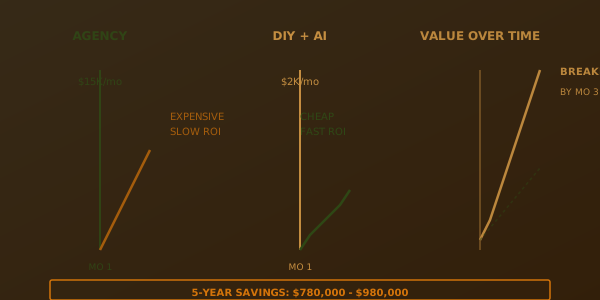
Your project didn't fill up one person's month. But an agency still needs to bill you for the full resource. So they allocate 30% of a senior strategist's time. Which means your work gets 30% attention. The other 70% goes to other clients. You're paying full rate for part-time attention.
5. Generalist Thinking**
Agencies need people who can work across multiple industries and problems. They can't hire specialists in growth strategy for B2B SaaS. They hire generalists who know "growth." You lose specificity for breadth.
The Cost Comparison: Agency vs. Fractional
Let's look at a real scenario.
Client Profile: $5M revenue B2B SaaS. Growth stalled. Need strategy on positioning, funnel optimization, and go-to-market. 6-month engagement.
Agency Route ($18K/month, 6 months = $108K):
- Month 1: Discovery meetings, lots of questions, internal kickoff. Senior strategist attends pitch, then disappears. Junior strategist doing the work
- Month 2-3: Analysis and recommendations. Junior strategist writing reports. Account manager managing timeline
- Month 4-6: Implementation and execution. More juniors, more execution staff. Senior strategist appears for big presentations
- Result: You've spent $108K. You have a playbook. But 80% of the work was done by junior staff thinking about your problem for the first time. The senior strategist was in the room 5% of the time
Fractional Route ($7.5K/month, 6 months = $45K):
- Month 1: Deep discovery. Same strategist every conversation. They're building context
- Month 2: Analysis and strategy. The same person who did discovery is now recommending. Continuity of thought
- Month 3-6: Implementation and refinement. Same strategist guiding execution. They see what works, adjust
- Result: You've spent $45K. You have a strategy and someone who knows your business intimately. You get 100% of a senior strategist's attention (part-time), not 5% of their time mixed with 95% junior staff
Cost per month: $7.5K vs. $18K (58% savings)
Quality of strategic thinking: Fractional wins (continuity + senior focus)
Implementation speed: Fractional wins (fewer handoffs, clearer direction)
When Agencies DO Make Sense
I'm not saying never hire an agency. There are legitimate reasons:
You need large-scale execution: Major brand refresh, full-funnel marketing rebuild, TV campaign launch, comprehensive website redesign. You need a team. Agencies are built for this.
You need specialized departments: Creative production, media buying, influencer management, video production. Agencies have those capabilities. Fractional operators don't.
You're enterprise and you need process: You have compliance requirements, approval layers, multiple stakeholders. Agency structure was built for this.
You need to absorb the risk of an underperforming team member: Agencies carry bench. If your account manager underperforms, they replace them. As a client, that's not your problem. With a fractional operator, if they underperform, you have to find someone new
You want arm's length distance: Sometimes you want it to be clear who works for whom. Agencies create that distance. It can feel safer, even if it's less efficient.
If none of those things are true - if you need senior strategy and execution, not scale and complexity - fractional is almost always better.
The Core Difference: Alignment and Accountability
Here's the real issue with agencies: misaligned incentives.
The agency is a business. They need to keep people busy. They need to hit utilization targets. They need to justify headcount. Their success is not your success. Their success is having enough billable clients to cover their overhead.
A fractional strategist has one incentive: deliver results. Why? Because results lead to word-of-mouth. Results lead to referrals. Results lead to more revenue. They're not trying to keep a team busy. They're trying to actually move the needle for you.
It changes decision-making. An agency might recommend a six-month, multi-layer initiative that requires multiple people. A fractional operator recommends the minimum viable strategy to get results in 90 days.
Which would you rather hear?
The Alternative: Fractional Strategy + AI Execution
Here's what $7.5K/month gets you with a fractional strategist:
- Strategic thinking - Same person for every conversation. Building context. Learning your business
- Fast decision-making - No layers. No approval chains. Strategy → decisions → action in days, not weeks
- Accountability - One person owns the results. They're directly incentivized by outcome
- Continuity - You don't re-explain your business every time you talk. Context compounds
- AI-powered execution - The strategist uses AI tools for research, content, analysis. More leverage. Faster execution
- Focus - They're focused on strategy and decisions. Not managing timelines or approval chains
You get 20 hours a month of senior strategy + execution leverage. You skip the overhead, the layers, the process.
The trade-off: you're not getting a team. You're not getting production at scale. You're getting a smart strategist who thinks deeply about your problem and moves fast.
For most growth-stage companies, that's the better trade.
What to Do If You're Currently With an Agency
Don't fire them tomorrow. But ask yourself:
- Who's actually responsible for results? Can you name one person? If it's a team of people, accountability is diffused
- Who's thinking about your business? Is it the same person every time, or does it change?
- Are decisions happening fast? Does strategy take three weeks to approve and implement, or three days?
- Are you paying for people you don't interact with? If you've never met the account manager, they're overhead you're funding
- Are you getting what you came for? Did you hire them for strategy or for execution? Are they delivering on the real thing you need?
If the answers suggest you're funding layers that don't serve you, it's time to look at alternatives.
The Bottom Line
You're not paying for strategy at most agencies. You're paying for a structure. You're paying for overhead. You're paying for people whose job is to manage other people's work.
If you need that structure - scale, production, complexity, multiple disciplines - agencies are the right tool.
If you need strategy, speed, and accountability - a fractional operator with leverage is almost always the better choice.
The businesses that win in 2026 aren't the ones throwing the biggest budget at the problem. They're the ones being strategically ruthless about where that budget goes and insisting on direct accountability for results.
Fractional strategy is how you do that.