The traditional agency model breaks on a simple math problem: leverage.
A 10-person agency making $150K per person all-in (salary, benefits, tools, overhead) costs $1.5M annually to operate. To break even, they need to bill $2M-$2.5M, which means a $15K-$20K monthly minimum across their client base. That's the cost of keeping the doors open.
A solo operator with AI tools costs $5K-$8K monthly all-in (Claude, Clay, Apollo, HubSpot, various integrations). Break-even is maybe $8K-$10K if they're disciplined about spending.
But here's the thing: that 10-person agency can't deliver more than the solo operator anymore. In fact, the solo operator is probably faster and more responsive.
This isn't a metaphor. I've watched it happen in real time.
The Output Comparison: What Actually Gets Delivered
Let's be specific about what clients actually need. For a $2M-$20M revenue brand, the core growth work is:
- Customer journey mapping and analysis
- Lead list building and outreach sequencing
- CRM setup and workflow automation
- Content strategy and asset creation (emails, landing pages, case studies)
- Monthly reporting and iteration
Here's how each model tackles it:
The 10-Person Agency Approach
- Strategy Lead (1 person, 5 hours on your account monthly) = $5K/mo contribution
- Implementation (2 people, 40 hours combined) = $12K/mo
- Content Creation (2 people, 30 hours combined) = $8K/mo
- Data & Reporting (1 person, 10 hours) = $2K/mo
- Account Manager as friction layer (1 person, overhead allocation) = $1.5K/mo
- Admin, meetings, delays (2 hours per week across the team) = Baked in
Cost: $28.5K/month to client. Typical engagement: 12-18 months. Typical output: 60-80 hours of actual work, spread across a team that's splitting attention.
The Solo Operator + AI Team Approach
- Strategy & Discovery (solo operator, 15 hours monthly) = Direct relationship, zero hand-off friction
- Lead Research & List Building (Claude + Clay, 2 hours of human direction) = Automated, repeatable
- CRM Setup & Workflow Automation (solo operator + Zapier integrations, 10 hours) = Faster implementation, zero delegation overhead
- Content Creation (Claude for initial drafts + solo operator refinement, 8 hours) = Faster turnaround than a team
- Data & Reporting (automated via CRM) = Self-service for client
Cost: $7.5K/month to client. Same engagement length. Actual output: 100-120 hours of directed work, with 40-60 hours of AI-powered leverage on top.
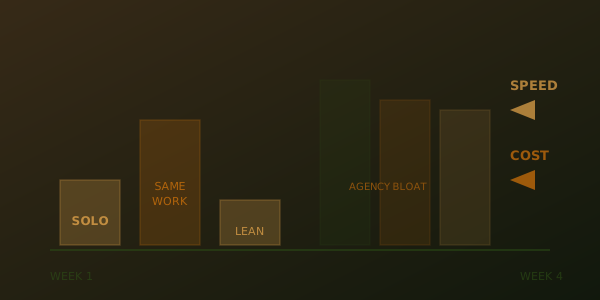
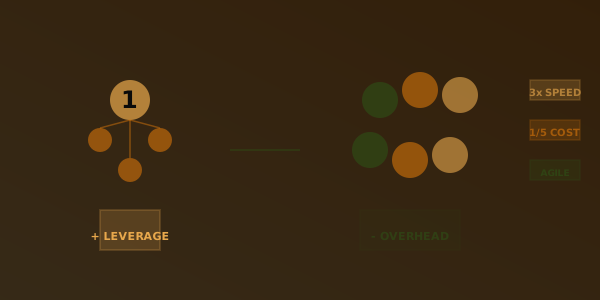
The solo operator delivers more hours, better coordination, and faster turnaround - for less than one-third the cost.
The AI Lab: What This Looks Like in Practice
When I talk about "AI team," I'm not being poetic. It's a real stack. Here's what I run:
Claude (Anthropic)
This is the brain. Strategy work, research, content creation, prompt engineering for workflows. I use Claude for customer journey analysis, competitive research, email copy, landing page strategy, even CRM flow design. The cost is negligible - maybe $100/month if I'm pushing it hard.
Claude doesn't replace my thinking. It eliminates the parts of thinking that are repetitive: research synthesis, first-draft creation, framework application. That frees my actual brain for judgment calls, client-specific strategy, and the insights that can't be automated.
Clay (Clay.com)
Lead research and list building. Define your ICP, Clay finds the companies and contacts. $500/month gets you unlimited searches and 50,000 monthly records. For B2B prospecting, this is the fastest way to build a target account list.
I use Clay to find accounts, then feed that list to Claude for enrichment and qualification. Clay does the bulk work, Claude adds the intelligence.
Apollo (Apollo.io)
Email verification, outreach sequencing, and deliverability infrastructure. $500/month for a decent plan. Apollo connects to your CRM, manages email sequences, and handles the technical side of prospecting - bounce rates, domain reputation, send timing.
This is where the leverage on outreach compounds. Instead of managing 50 email threads manually, Apollo manages 500 or 5,000 with automation.
HubSpot (Free or Pro)
The CRM layer. HubSpot Free keeps everything coordinated - deals, contacts, pipeline. If you need more (workflows, advanced reporting, email integration), Pro is $50/month. Most small clients don't need it; I set up Free and it's powerful enough.
HubSpot is where the system actually lives. It's not sexy, but it's the nerve center that prevents chaos.
Zapier ($20-50/month)
The connective tissue. Zapier moves data between tools. When Apollo sends an email, Zapier logs it in HubSpot. When a lead converts, Zapier creates a deal. No manual data entry. Ever.
Total AI lab cost: ~$1.1K/month in tools. Add my time (let's call it $5K/month for a fractional operator), and you're at $6.1K before software, home office, or any other overhead.
A single mid-level strategist at an agency costs more than the entire stack.
The Expertise Leverage Point
This is where people get confused. They think AI replaces expertise. It doesn't. AI eliminates labor, which is completely different.
Expertise is judgment. It's knowing which growth vector matters for this particular client. It's recognizing a messaging mismatch in their funnel that nobody else has caught. It's understanding why a feature in their product is killing conversion and what to do about it.
Those decisions still require a human who knows what they're doing. AI doesn't replace that. It just removes the busywork that keeps you from doing it.
I spend 30% of my time on strategy - the hard thinking. I spend 60% on execution - the stuff that's now AI-assisted. I spend 10% on administrative overhead. A traditional consultant spends maybe 20% on strategy, 50% on execution, and 30% getting tangled up in meetings and approval cycles.
Because I'm not managing people, I don't have the overhead. Because AI handles the repetitive execution, I'm free to focus on the strategy part - which is what clients actually pay for.
Specific Output Comparison: 90 Days of Real Work
Let's run a 90-day case study with the same client profile: a $5M SaaS company trying to expand their enterprise vertical.
What the Agency Delivers
- Discovery interviews (4 sessions, 2 weeks in) = 12 hours of notes, 8 hours to synthesize into a memo
- Customer journey mapping (20 hours) = One deliverable, usually a PDF deck
- Enterprise account list (10 hours of research) = Spreadsheet of 200 accounts
- Email sequence design (20 hours across 2 people) = 5-email sequence template
- Landing page copy (30 hours) = Single page draft, 2 rounds of revision
- Reporting (8 hours) = Monthly deck, usually 15 slides of metrics
- Ad hoc revisions, meetings, approvals = 20 hours of invisible time
Total: ~98 hours of calendar time, delivered as 6-7 discrete deliverables over 90 days. Cost to client: ~$42K.
What the Solo Operator + AI Delivers
- Discovery interviews (same 4 sessions) = 12 hours of notes
- Customer journey mapping (Claude assists with frameworks) = 8 hours to output, 3 months of living documentation in HubSpot (not a static PDF)
- Enterprise account list (Clay finds 500 accounts, Claude qualifies them) = 4 hours of setup, continuously updated
- Personalized email sequences (Claude generates + operator refines) = 12 hours total, but personalized per account (not templates)
- Landing page copy (Claude drafts, operator refines, tested live) = 12 hours, but continuously optimized
- Reporting (HubSpot native dashboards + monthly review) = 4 hours, real-time access for client
- Ongoing optimization and iteration = Built into the engagement (not a separate service)
Total: ~74 hours of directed work, but 150+ hours of AI-assisted execution. 10+ deliverables, with continuous iteration. Cost to client: ~$18K-$22K depending on engagement length.
The solo operator delivers 2-3x the actual output, faster iteration, lower cost, and direct access to the decision maker. The agency delivers a portfolio piece and a relationship with an account manager who won't be there in 6 months.
Where Agencies Still Have an Advantage (And It's Shrinking)
I'm not going to pretend the agency model has no advantages. There are a few:
Specialization at Scale
If you need a video production team, a data scientist, and a PR specialist all working in concert, an agency can assemble that. A solo operator can't (easily). This is real for clients doing $50M+ revenue who can absorb that cost.
Institutional Knowledge
A 10-person agency has seen 50 different client situations. They can draw patterns across industries. A solo operator is seeing 3-5 situations at a time. That's fewer data points (but more depth on each one).
Risk Transfer
Hiring a 10-person agency feels safer than hiring a solo operator. If the solo operator quits or gets hit by a bus, you're exposed. An agency can theoretically transition you to another person on the team. (In practice, this rarely works well, but it's the perception.)
That's it. Those are the advantages. And all three are shrinking:
- Specialized agencies are consolidating into super-specialized boutiques. The generalist agency is dead.
- AI is compressing the knowledge gap - a solo operator can tap decades of frameworks and case studies instantly via Claude and web research.
- The best solo operators are building operating partners and small networks to mitigate bus risk.
The $7.5K vs. $15K Decision
Let me be direct: most clients I work with would have spent $15K-$20K/month with an agency for this exact work. They came to me at $7.5K because they found me through content or referral and wanted to test fractional strategy.
They stayed at $7.5K because the output was better and the relationship was simpler.
The math works because I'm not carrying organizational overhead. I'm not paying for office space, manager salaries, benefits, or the inefficiency that comes with multiple people touching the same work.
Every dollar of my cost goes toward either tools that generate output or my time. There's no waste layer. There's no account manager reminding me to send a status update. There's no meeting about meetings. There's just work and results.
The One Thing Agencies Get Right That Solo Operators Miss
Agencies are built to scale output. They can take on 20 clients and systematize the delivery. A solo operator hits a wall at 3-5 clients because the work is bounded by time.
This is why I don't position myself as a replacement for all agency work. I'm not for clients who need 200 hours/month of support. I'm for clients who need 40-60 hours of strategic work, leveraged by AI.
That's most growth-stage B2B companies, actually. Most don't need a full team. They need a good strategist who can move fast and make decisions, backed by tools that handle the repetition.
Agencies over-staff for the work required. Solo operators under-staff relative to the output they can produce.
The Future (2026 and Beyond)
I think this trend accelerates. More expertise-driven work will migrate to solo operators and small networks. Agencies will consolidate into either super-specialized boutiques or execution mills.
The bottleneck in growth strategy isn't labor. It's expertise. And expertise is more concentrated in individuals than in firms.
If you're evaluating between hiring an agency and hiring a fractional operator, run the same 90-day test I described above. Get the proposals. Compare actual deliverables, not pitch decks. Ask for references. Talk to people who are 6 months in, not day-one happy.
I suspect the solo operator with good tools and a track record will win that comparison most of the time.
And if you're considering going fractional, this is the moment. The tools are good enough, the AI is smart enough, and the business case is clear. You don't need a full team anymore. You need a strategist with leverage.
That's what you're actually paying for anyway.