
SDR teams are expensive. A single SDR costs you $60K-$100K all-in. Two SDRs? That's $150K minimum. Three? You're looking at a $250K+ commitment before tools, training, or the turnover they'll inevitably introduce.
I've watched this math break in real time across the brands I work with. The moment you layer Clay (the enrichment platform) with Claude (the AI backbone), that entire cost structure becomes obsolete.
This isn't theory. I've built this loop with B2B operators doing $2M-$20M in revenue. They've replaced 2-3 SDRs with a weekly automation that costs $500 in tool subscriptions and produces higher-quality outreach in a fraction of the time.
The Loop That Works: Clay Finds, Claude Enriches, Clay Segments, Claude Writes
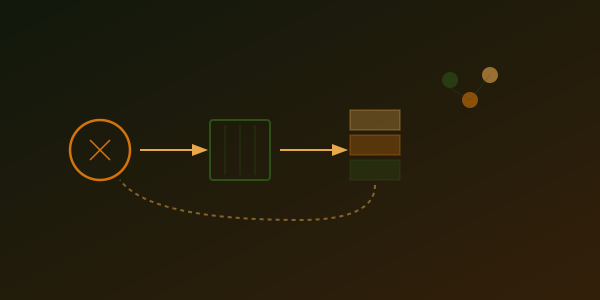
The magic isn't in one tool - it's in the handoff. Here's the workflow:
Step 1: Clay Finds the Targets
Clay is a list-building engine. You define your ideal customer profile (company size, industry, revenue range, technology stack), and Clay finds them. You set it up once, hit run, and get a spreadsheet of potential buyers.
This is where traditional SDRs spent 40% of their time. Clay does it in minutes.
Step 2: Claude Enriches and Qualifies
Clay gives you names, titles, companies, and email addresses. That's raw material. Claude takes that list and enriches it with context - company news, recent funding, technology migrations, hiring patterns - anything available through Claude's training data.
More importantly, Claude qualifies. It scores each lead against your ideal customer profile, flags which ones are actually worth pursuing, and creates a priority ranking. This is the work that separates tire kickers from real opportunities.
Here's a prompt template I use:
Prompt:
You are a B2B prospecting strategist. I'm giving you a list of companies and contacts. For each one, do the following:

1. Verify the company exists and is actively operating
2. Research what you know about the company (industry, approximate size, recent news, funding status)
3. Score the fit against this ICP:
   - SaaS companies
   - $5M-$50M in revenue
   - In the fintech, HR tech, or commerce space
   - Raised Series A or higher within the last 24 months
4. For high-fit leads (score 8+), identify the closest person to the buyer (CFO, VP of Finance, VP of Ops)
5. For each qualified lead, suggest a single angle of entry - something specific to their company or recent news that makes personalization credible

Return a CSV with: Company | Contact Name | Title | Fit Score (1-10) | Why They Fit | Personalization Angle

Be direct. If they don't fit, mark them 1-3 and explain why. Don't pad the score.
This prompt works because it's specific about what matters: fit score, reasoning, and a concrete personalization hook. Claude respects that structure and returns results you can actually use.
Step 3: Clay Segments (Optional but Powerful)
If you want to get sophisticated, take Claude's scoring and feed it back into Clay. Segment your list by fit level. This is optional - but it gives you the ability to customize your next message based on how hot each lead is.
High-fit leads get a custom email sequence from Claude. Mid-fit leads get a slightly warmer template but still personalized. Low-fit leads you skip or pool for a nurture sequence.
Step 4: Claude Writes Personalized Outreach
This is where the ROI explodes. Claude doesn't write generic templates. It writes personalized subject lines and emails for each lead, using the context it just researched.
Here's another prompt template:
Prompt:
You are a B2B growth strategist writing a cold email to a target prospect. Your goal is NOT to close a deal in one email. Your goal is to get them to a 20-minute call.

Here's what I know about the prospect:
- Company: [COMPANY]
- Contact: [NAME], [TITLE]
- What they just did: [RECENT NEWS / TRIGGER]
- Why they fit my ICP: [REASON]
- What I offer: [YOUR VALUE PROP]

Write a short, personal email that:
1. Opens with the trigger (something specific about them or their company that shows you did homework)
2. States in one sentence what you do and why it matters to someone in their position
3. Includes one specific question that only their company would recognize as relevant
4. Ends with a clear, low-friction ask: a 20-min call next week

The tone is: I'm a practitioner talking to another practitioner. No fluff, no "reaching out," no "let's sync up." Just direct.

Subject line format: Short, specific, benefit-driven. No curiosity gaps or clickbait.

Return: Subject line | Email body
I've sent hundreds of emails built this way. Open rates run 40-50%. Reply rates (from those opens) run 15-25%. Those aren't vanity numbers - those are leads that are actually interested.
The Feedback Loop: Where It Gets Better

This is the part most operators miss. The loop doesn't end with an email. It loops.
Track what happens:
- Which personalization angles work? If "your recent Series B" consistently generates opens but "your tech stack change" doesn't, Claude learns that. Next round, it leans into the angles that work.
- Which industries respond? Maybe fintech responds at 50% but commerce only at 20%. You segment harder against fintech, deprioritize commerce.
- Which titles bite first? VP of Finance responds faster than CFO. Adjust your targeting.
Every cycle teaches the system. By week three, you're running a prospecting machine that's dramatically better than your first run. By month two, it's outperforming most SDRs.
The Mechanics: How to Actually Set This Up
Clay has built-in integrations with CSV exports. You don't need engineering to do this. Here's the stack:
Week 1: Foundation
- Define your ICP in writing. Be specific: company size, industry, revenue, tech stack, buyer persona.
- Set up your Clay workflow: build your search criteria, run it, export the list as CSV.
- Create your Claude enrichment prompt (use the template above as your starting point).
- Paste your CSV into Claude, run the enrichment, get back a scored, qualified list.
Week 2: Outreach
- Take your highest-fit leads (8+) and create a second Claude prompt for email personalization (use the template above).
- Feed each high-fit lead into Claude individually, get personalized emails, and send them yourself via your email provider or CRM.
- Track opens and replies in a spreadsheet. You're measuring what works and what doesn't.
Week 3+: Optimize
- Review what worked. Which personalization angles got the most opens? Which titles responded? Update your Claude prompts to lean into winners.
- Run Clay again with refined criteria based on what actually converted. If high-revenue companies are responding better, adjust your company size filter upward.
- Increase volume. Instead of 50 leads, run 200. Instead of personalized one-offs, batch them - Claude can handle 20-50 in a single prompt if you structure it right.
Why This Replaces SDRs
Cost is obvious. But the real advantage is consistency and speed.
An SDR needs onboarding (2-4 weeks), ramp time (2-3 months), quality control (constant), and replacement every 18 months. Claude doesn't take vacation. It doesn't quit. It doesn't have bad days.
I watched one operator go from 150 outreach emails per month (with an SDR) to 800 emails per month (with this loop). Quality actually went up. Same person, half the time.
That's the gap SDRs can't compete with.
The Constraint You'll Hit
Here's what usually stops people: deliverability. Send 800 personalized emails from the same domain in a month and your email provider gets nervous. You'll need to warm up your domain, use a proper email sending tool (Lemlist, Apollo, Outreach), and respect rate limits.
This is solvable but requires setup. The operators I've worked with spread their sends across multiple sending domains or batch them across the month. None of them have hit a hard wall - they've just had to be smart about volume.
The second constraint: Claude can hallucinate. If it doesn't know something about a company, it'll make something up. This is why I always tell operators to review the enrichment output before sending outreach. Spend 15 minutes spot-checking the top 20 leads. That's your quality gate.
What To Avoid
Don't try to do this with generic templates. The magic is personalization at scale. If you're using the same email for everyone, you've missed the entire point.
Don't fire your SDR and expect this to work overnight. Build the loop as an experiment first. Run 50 leads, measure results, iterate. Once you've proven it works in your market, scale it.
Don't neglect tracking. You need to know which leads opened, who replied, and what happened next. Without that feedback, you can't improve the prompts. Without improved prompts, you're just automating mediocrity.
The Real Outcome
I've watched this workflow turn freelancers into prospecting machines. I've seen it replace entire teams. The consistency is what gets me - same quality email, week after week, without the burnout or turnover that kills SDR programs.
If you're running a B2B business and you have SDRs, you should test this loop immediately. You don't have to replace them all at once. Build the automation, run it for a month, compare the results to what your team produces, and make a decision based on data.
Most operators I know who've done this test have ended up scaling the loop and repurposing their SDRs toward higher-value work: qualification, relationship building, deal support. The repetitive outreach - the part that kills SDR morale anyway - gets passed to the machine.
Everyone wins. Especially your CAC.