
You're a fractional consultant, a small agency, or a solo operator with deep expertise. You're competent. Your work is strong. But nobody knows you exist.
You're chasing opportunities that don't convert. You're competing on price because nobody knows the value you bring. You're selling features instead of outcomes because your positioning is invisible.
Enterprise buyers don't search for agencies. They search for answers. They read articles. They follow thought leaders. They join communities where experts hang out. Then they hire based on trust and evidence of thinking.
This is why thought leadership wins. It's not about getting your name out there. It's about positioning yourself as the obvious expert choice in a specific category. It's about letting high-value clients come to you because you're already solving their problems publicly.
Here's how to build it.
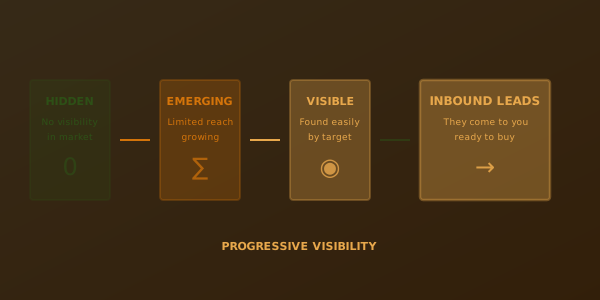
Own Your Category: Category-of-One Positioning
You can't be "a growth consultant." That's too broad. Neither can you be "the best growth consultant" - nobody believes that.
You can own an intersection. A specific combination of expertise that no one else occupies.
I own "growth strategy for founders obsessed with customer experience." That's narrow. It's specific. It tells you exactly who I work with and what I care about. It's ownable in a way "growth consultant" will never be.
To find your intersection, ask:
- What problem do I solve better than anyone else?
- Who has that problem most acutely?
- What's the intersection of my expertise and their obsession?
- Can I own language around that intersection?
Some examples: "Marketing operations for B2B SaaS founders." "CRM strategy for high-volume sales organizations." "Customer success design for PLG companies." "Demand generation for AWS partners."
Notice they're all specific. They all combine a domain (who), a problem (what), and often a constraint or context (where/when). That specificity is where your power lives.
Once you own the intersection, you own the language. You own the narrative. Enterprise buyers searching for that thing find you.
Three Content Pillars: Show, Teach, Prove
You've got one intersection to own and limited time. You need a content strategy that compounds your authority.
I recommend three pillars:
Pillar 1: Share Methodology
Show people how you think. Not the entire process - your methodology is your edge. But the frameworks, the approach, the principles.
This serves two purposes. First, it educates your audience and attracts inbound demand. Second, it qualifies buyers. If someone reads about your approach and doesn't like it, they're not your customer. That's efficient.
Examples of methodology content:
- The three-step framework you use to diagnose problems
- How you approach positioning strategy
- The metrics you look at first with a new client
- Your process for prioritizing opportunities
- How you think about retention vs. acquisition trade-offs
This content gets saved. It gets shared. It becomes the definition of your thinking in your space.
Pillar 2: Show Results (Not Just Case Studies)
Case studies are standard. Everyone has them. What's rare is teaching through results.
Take a real outcome from your work. Not "we helped a B2B company grow." Real: "We rebuilt the funnel architecture for an enterprise SaaS company and moved their average deal value from $47K to $156K without changing sales team size."
Then tell the story. What was broken? What did we change? How did we measure it? What happened next?
This is more compelling than a case study because it's narrative-driven. It shows your thinking. It shows the results were earned through strategic work, not luck. Enterprise buyers see themselves in the story.
Specific result examples:
- Repositioned a commoditized service into a category-of-one and tripled inbound leads in 6 months
- Mapped a customer's tech stack and identified $200K in redundant tools that could be eliminated
- Found a messaging gap that was causing 40% of qualified prospects to choose competitors, fixed it, and moved win rate from 28% to 54%
- Built a referral system that moved the company from 15% to 67% of new revenue coming from existing customers
Pillar 3: Teach Frameworks That Stick
The most shareable content teaches something memorable. A framework. A checklist. A way of thinking.
I publish regularly about frameworks: how I audit a customer journey, the metrics I track, how I think about ICP clarity, what I look for in competitive positioning. These get saved. They get used. People reference them to their teams.
When someone says "I use the CXPromise audit framework," I win. They're spreading my methodology. They're embedding my way of thinking into their organization. And when they're ready to hire me, I'm the obvious choice.
Teachable frameworks:
- The 5-step positioning audit
- The 3-layer funnel health assessment
- The growth opportunity prioritization matrix
- The ICP clarity checklist
- The customer conversation guide
Repurposing Strategy: One Idea, Many Formats
You don't have time to create entirely new content every day. You need a repurposing system.
Start with one insight. One framework. One result.
Then deploy it across formats:
- Blog post (1,200 words) - The full treatise. Your methodology, examples, why it matters, how to apply it.
- LinkedIn posts (3-5 variations) - Different angles from the same post. One focuses on the problem. One focuses on the solution. One focuses on results. One is a question. One is a framework callout.
- LinkedIn article (500 words) - A condensed version published directly on LinkedIn. Drives more reach than standard posts.
- Email series (3-4 emails) - Breaking the blog post into segments. Each email builds on the previous one and drives to a call-to-action.
- Talking points for sales calls - When you're on calls with prospects, reference the framework. It positions you as someone who thinks deeply.
One piece of original thinking, deployed five ways. That's leverage.
The 90-Day LinkedIn Playbook
You don't need to be on LinkedIn forever to see results. You need to be consistent for 90 days. Here's the execution plan:
Month 1: Establish Authority
Publish three pieces of original content. Blog posts, frameworks, or detailed results posts. The goal is to give evidence that you know your stuff.
Post daily on LinkedIn. Not three-paragraph essays - short posts that reference your bigger thinking. "Just finished a customer journey audit. Typical findings: 40% of prospects drop at the first friction point, which is usually the CRM form. One fix we made last week: removed three fields, acceptance rate went from 32% to 67%."
Engage consistently. Comment on other people's posts in your space. Don't spam. Add real thinking. This puts you in the conversation and signals that you're active.
Build your list. Every post should have a comment that directs interested people to an email list or a free resource. "Want the audit framework? Comment 'methodology' and I'll send the checklist."
Month 2: Build Reach & Engagement
Publish three more pieces of original content. Go deeper on frameworks. Show more results. Teach more.
Daily posting, but now you're experimenting with formats. Some days it's a short teaching post. Some days it's a question. Some days it's a behind-the-scenes look at a client engagement. Some days it's a contrarian take on your space.
Start conversations. Ask questions. Get people talking. The algorithm rewards engagement, and conversations that feel real matter.
Sequence your connections. You should be connecting with ideal customers in your space - founders, CMOs, VPs of Growth, heads of revenue in companies that fit your ICP. 20-30 intentional connections per week, focused and specific.
Month 3: Convert & Establish Pattern
Publish three more pieces. You now have nine pieces of original thinking. That's enough to position yourself as a thought leader in your space.
Your daily posts are now conversational. You're not trying to prove yourself anymore - you've done that. You're now having conversations with your audience. You're sharing wins. You're asking questions. You're engaging with others' ideas.
Your inbound should be flowing. People who've been following you for 90 days are now warm. They know your thinking. They see your results. They trust your judgment.
Time to ask. Invite the warmest connections to a call. "I've loved your thinking on X. Would be great to connect. 20 minutes?" Open rate on these is 30-40%.
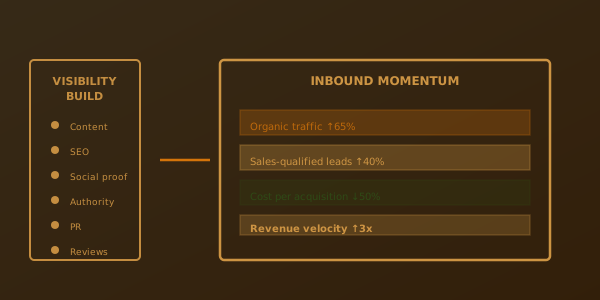
Converting Followers to Conversations to Clients
Thought leadership doesn't sell directly. It sells indirectly. It builds trust. It qualifies buyers. It creates inbound gravity.
Here's the conversion sequence:
Stage 1: Follower - Someone follows you because they like your thinking. They might never buy. That's fine. They're seeing your authority compound.
Stage 2: Engaged Follower - Someone who comments, shares, engages with your content regularly. They're signaling interest.
Stage 3: Conversation - You reach out. "Noticed you engage with content about growth strategy. Would be helpful to chat about what you're working on." You get a conversation without cold outreach friction because they already know you.
Stage 4: Prospect - In the conversation, you learn about their situation. You might see an obvious fit. You might suggest a paid engagement. Or you might recommend they read more content first. Either way, they know where to find you.
Stage 5: Client - Some conversations turn into paid work. They book an audit. They hire you as a fractional strategist. They see the value because you've already proven your thinking.
Not everyone moves through this sequence. That's expected. But the people who do move through this sequence are warm, qualified, and sold on your approach before they ever buy.
Why Enterprise Buyers Trust Thought Leaders
Large organizations move slowly. They need multiple approvals. They're risk-averse. They want proof you know their world.
When you're a thought leader in your space, you've already provided that proof. You've shown your methodology. You've taught frameworks they recognize. You've shared results from companies like theirs. You've positioned yourself as someone who understands their specific challenges.
That trust is worth millions in sales acceleration. It's the difference between cold outreach (low conversion) and warm inbound (high conversion).
Enterprise buyers also buy with conviction. They don't want the cheapest option or the flashiest pitch. They want the person who's thought deepest about their problem. The person who's building a business around solving it. The person who's sharing their methodology for free because they're confident in their approach.
That's a thought leader.
Post Format Examples That Work
If you're starting from zero on LinkedIn, these formats work consistently:
Format 1: Problem + Insight
"Most growth leaders focus on acquisition and ignore retention. But your best customers generate 3-5x more expansion revenue than your average customer. The math: if you improve retention by 5%, you're adding 15-20% more lifetime value. That's your biggest lever for growth. How much time does your team spend on retention vs. acquisition?"
Format 2: Framework Callout
"When I audit a funnel, I look at three things first: 1) Conversion rate by stage - where are people actually dropping? 2) Time in stage - is your sales cycle slow because of you or because you're not attracting the right people? 3) Friction points - how many unnecessary steps before someone gets value? These three metrics predict 70% of your growth potential."
Format 3: Before/After from Real Work
"Helped a B2B services company reposition from generic 'digital strategy' to 'CX strategy for eComm brands.' Before: losing deals to agencies because buyers saw us as a commodity. After: the phone rings every week with inbound leads, and we're competing on value instead of price. Positioning isn't just marketing - it's the floor of everything else."
Format 4: Contrarian Take
"Most agencies will tell you to hire an in-house team. Wrong. Most agencies will tell you to hire them. Wrong. The real answer: hire a fractional strategist for thinking and direction, then bring in specialists for execution. You get senior-level strategy without full-time overhead. It's the new model and it works."
Format 5: Question
"Quick question: when you brought on a new client, how long did it take before you could articulate exactly who they should be selling to? If it's more than a week, you've got a discovery process problem. Share your timeframe below."
The Compound Effect
Thought leadership doesn't work in month one. You'll get followers, engagement, maybe one coffee conversation. That feels slow.
But by month three, by month six, by year one, you've created a gravitational field. You've positioned yourself as the expert in your category. You've built an audience of people who think like you. You've created inbound gravity.
Now you don't cold outreach. Ideal customers come to you. They've read your content. They know your approach. They're sold on your methodology. They're asking for your time.
That's the power of thought leadership. Not ads. Not networking. Not cold outreach. Teaching and proving. Building and compounding.
You'll never be invisible again.